
Dividend Snapshot – Reliance Chemotex Industries Limited
Reliance Chemotex Industries Limited (NSE: RELCHEMQ, BSE: 503162) has declared a final dividend of ₹0.50 per share for the financial year ended March 31, 2026. On the ₹10 face value, that headline reads as a 5% dividend — but the real market yield for a buyer at the current price of about ₹115 is only 0.43%. This Reliance Chemotex dividend is small in rupee terms, yet the company has kept its payout streak unbroken through a weak-profit patch, which is the more interesting story for income-focused investors.
Key Figures
- Dividend per share: ₹0.50
- Dividend rate: 5% (on ₹10 face value)
- Dividend type: Final Dividend
- Real market yield: ~0.43%
- Record date: 18 September 2026
Why It Matters
- Total outflow only ~₹0.38 Cr
- Payout ratio: 7.2% of profit
- Dividend cover: 13.9x earnings
- FY26 net profit: ₹5.26 Cr
- Promoter share of payout: ~₹0.26 Cr
Company Overview – Reliance Chemotex Industries Limited
Incorporated in 1977, Reliance Chemotex Industries Limited is a Udaipur-based textile manufacturer that makes and sells synthetic and blended yarn. It is a micro-cap company with a market capitalisation of roughly ₹87 Cr and a single manufacturing base at Village Kanpur, Udaipur, Rajasthan.
The business sits in a cyclical, input-cost-sensitive part of the textile chain. Over FY26 it reported net sales of about ₹362 Cr with a thin net margin near 1.5%, which is typical for commodity yarn spinners. The promoter family holds 67.68%, and there is effectively no institutional ownership — FII and DII holdings are both 0% (source: exchange shareholding pattern, June 2026 quarter). That ownership profile keeps the free float small and trading volumes light.
Financial Analysis – Reliance Chemotex Industries Limited
FY26 Headline Numbers
- Net sales: ₹362.01 Cr
- Operating profit (PBDIT): ₹40.71 Cr
- Net profit (PAT): ₹5.26 Cr
- EPS: ₹6.97
- Book value/share: ~₹189
Returns & Leverage
- ROE: 3.76%
- ROCE: 7.34%
- Debt-to-equity: 1.90x
- PAT YoY (FY25→FY26): +29.9%
- 3-yr PAT CAGR: -24.9%
The picture is mixed. FY26 profit rose nearly 30% over FY25, helped by a 26% jump in operating profit. But step back three years and the trend is negative: PAT has fallen from ₹12.42 Cr in FY23 to ₹5.26 Cr in FY26 (Source: Screener.in). Returns stay low and leverage is high, so the recent bounce is a recovery off a weak base, not a structural turnaround.
Reliance Chemotex Industries Dividend History
| Financial Year | Dividend Type | Dividend/Share | Record Date |
|---|---|---|---|
| FY2025–26 | Final | ₹0.50 | 18-Sep-2026 |
| FY2024–25 | Final | ₹0.50 | 19-Sep-2025 |
| FY2023–24 | Final | ₹1.00 | 05-Sep-2024 |
| FY2022–23 | Final | ₹2.50 | 15-Sep-2023 |
| FY2021–22 | Final | ₹2.50 | 20-Sep-2022 |
| FY2020–21 | Final | ₹2.00 | 09-Aug-2021 |
Source: NSE/BSE corporate actions, compiled via public dividend records.
Expert Commentary – Reliance Chemotex Industries Limited
The honest read on this Reliance Chemotex dividend is that it is a token payout, cut to a quarter of its earlier size. From ₹2.50 per share in FY22 and FY23, the final dividend dropped to ₹1.00 in FY24 and has settled at ₹0.50 for two years running. The ₹0.50 is comfortably affordable — it eats just 7.2% of FY26 profit — but the shrinking trend tracks the fall in earnings, not a deliberate shift to buybacks or reinvestment.
For yield-seekers, the number that matters is 0.43%, far below what a liquid fund or even a savings account pays. The dividend here is best seen as a signal of continuity from a 48-year-old promoter-run business, not as a source of income.
Reliance Chemotex Industries Dividend Outlook
The company has not disclosed any forward dividend policy or target payout, so the future path is Not Disclosed by Company. What the data allows is a conditional read: with a payout of only 7.2% and earnings cover of 13.9x, the ₹0.50 dividend is easy to maintain even if profit stays thin.
The constraint is not affordability but priorities. Reliance Chemotex is in a heavy capex phase (FY26 investing outflow of about ₹81 Cr) funded largely by debt, with debt-to-equity near 1.90x. Until that capital cycle eases and returns improve, a meaningful dividend hike looks unlikely — though this is editorial reasoning from disclosed numbers, not a company forecast.
Dividend Announcement Summary – Reliance Chemotex Industries Limited
The Board of Reliance Chemotex Industries Limited recommended the final dividend of ₹0.50 per share for FY2025–26 at its meeting on 29 May 2026, alongside the audited annual results. In a separate filing dated 11 August 2026, the Board fixed the record date and book closure for the 48th Annual General Meeting and the dividend payment.
- Register of Members / Share Transfer Books closed: 18–24 September 2026 (both inclusive)
- Record date for dividend and AGM: 18 September 2026
- Cut-off date for e-voting: 18 September 2026
- Remote e-voting window: 21 September (9:00 AM) to 23 September 2026 (5:00 PM)
The dividend is subject to shareholder approval at the AGM, as is standard for a final dividend under the Companies Act, 2013.
Key Dates Timeline – Reliance Chemotex Industries Dividend
| Event | Date | Status |
|---|---|---|
| Board recommendation | 29 May 2026 | Disclosed |
| Record date / book closure start | 18 September 2026 | Disclosed |
| Ex-date | 18 September 2026 | Per public records |
| AGM | 24 September 2026 | Disclosed |
| Payment date | Not Disclosed by Company | Within 30 days of AGM (statutory) |
Under the Companies Act, 2013, a declared dividend must be paid within 30 days of declaration at the AGM.
Reliance Chemotex Industries Dividend Yield
This is where the face-value illusion bites. The dividend is often quoted as "5%," which is correct only against the ₹10 face value. The yield that a real investor earns is the dividend divided by the market price.
- Yield at current price (₹115): ₹0.50 ÷ ₹115 = 0.43%
- Yield at announcement-date price (~₹119): 0.42%
- Headline "5%" vs real yield: a ~11.5x overstatement
So a shareholder putting ₹1,00,000 into Reliance Chemotex shares at today's price would receive roughly ₹430 a year in dividend. The "5%" label describes the coupon on face value, not the return on money invested — a distinction retail investors frequently miss.
Reliance Chemotex Industries Dividend History Analysis
Reliance Chemotex has paid a final dividend every year for at least six years, which qualifies it as a consistent payer on frequency. On amount, however, the trend is clearly declining: ₹2.00 (FY21) → ₹2.50 (FY22, FY23) → ₹1.00 (FY24) → ₹0.50 (FY25, FY26).
There have been no special dividends, no interim dividends, and — importantly — no outright suspension or skip. The dividend was cut, not cancelled, as profits fell from ₹24 EPS in FY22 to ₹4–7 range thereafter. The pattern fits a cyclical business that protects a symbolic payout through down-years rather than a growth-dividend compounder. For FY26, holding ₹0.50 flat against a 30% profit rise signals caution, not confidence.
Reliance Chemotex Industries Financial Performance Analysis
The operating-leverage story in FY26 is positive but narrow. Revenue was almost flat (+1% YoY to ₹362 Cr), yet operating profit rose 26% and PAT 30%. That gap means the improvement came from margin recovery and lower tax/deferred-tax drag, not from sales growth.
The longer lens is less flattering. Over five years sales growth has averaged a weak ~7% (5-yr) while the 3-year PAT CAGR is -25% (Source: Screener.in). Net margin at roughly 1.5% leaves almost no cushion: a modest rise in raw-material (polyester/viscose fibre) costs or power tariffs can wipe out the bottom line. The FY26 recovery is real but sits on a fragile margin base.
Reliance Chemotex Industries Cash Flow Analysis
Reported profit is an opinion; cash is a fact — and here the two diverge. Operating cash flow is healthy relative to the dividend: FY26 OCF of roughly ₹18 Cr covers the tiny ₹0.38 Cr outflow about 48 times over.
The catch sits below OCF. The company spent heavily on investing activities — an FY26 investing outflow near ₹81 Cr — which pushes free cash flow deeply negative (roughly –₹64 Cr on our estimate). That capex was funded through financing inflows of about ₹60 Cr, i.e. fresh borrowing. In plain terms: the ₹0.50 dividend is paid out of operating accruals, but the company as a whole is cash-negative and adding debt, so the payout coexists with external funding needs. This is the kind of detail wire-service summaries skip.
Reliance Chemotex Industries Balance Sheet Strength
Strengths
- Reserves of ~₹126 Cr vs tiny ₹7.5 Cr equity capital
- Book value ~₹189/share vs price ~₹115 (P/B ~0.6)
- Trading below book value
Pressure Points
- Debt-to-equity 1.90x — elevated
- Low interest-coverage flagged by data providers
- Cash & equivalents thin (~₹0.4 Cr)
The balance sheet carries large accumulated reserves and trades below book value, which looks attractive on paper. But those reserves are tied up in fixed assets and working capital, not sitting as cash. With debt-to-equity near 1.90x and a low interest-coverage ratio, the company's financial flexibility is limited — a reason the dividend stays symbolic rather than generous.
Reliance Chemotex Industries Dividend Sustainability
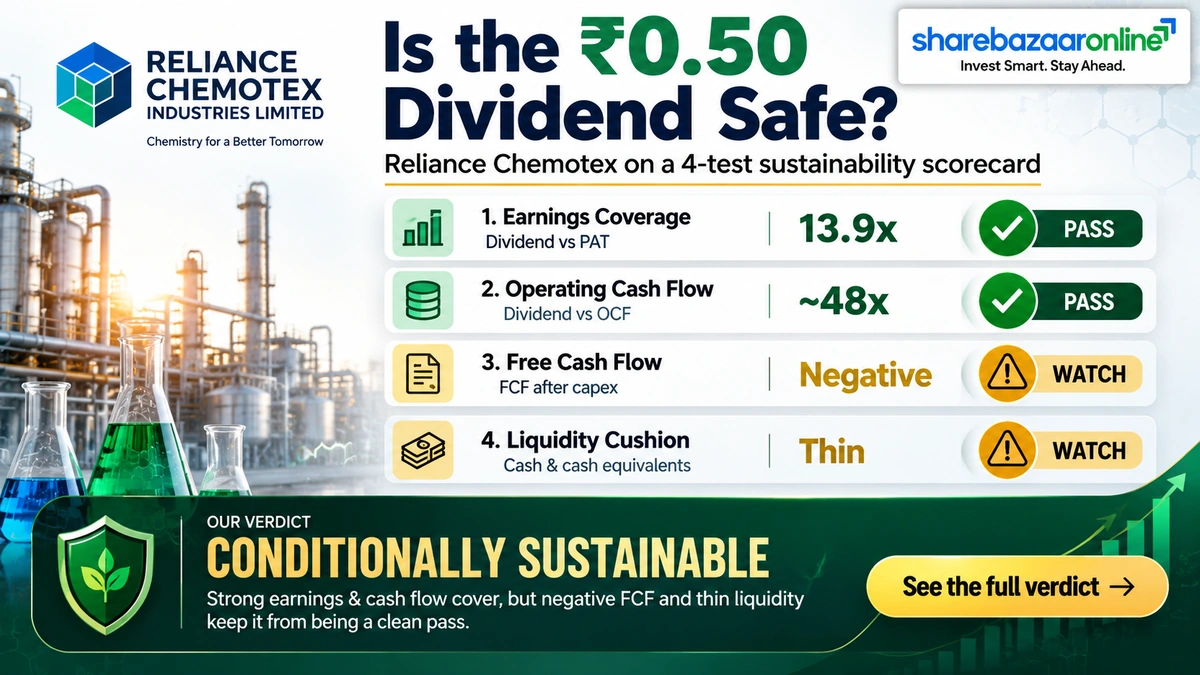
On our four-test scorecard, the ₹0.50 Reliance Chemotex dividend scores well on the measures that matter at this size:
- Earnings coverage: 13.9x (payout 7.2%) — very strong
- OCF coverage: ~48x — very strong
- FCF coverage: negative FCF — fails this test
- Liquidity/cash: thin cash, high debt — weak
Verdict: Conditionally Sustainable. The payout is so small that earnings and operating cash flow cover it many times over, so a cut is unlikely on affordability grounds. The condition is that it coexists with negative free cash flow and rising debt — the dividend survives because it is tiny, not because the company is cash-rich.
Reliance Chemotex Industries Dividend vs Peers
| Company | Div. Yield | ROE | ROCE |
|---|---|---|---|
| Reliance Chemotex | ~0.43% | 3.76% | 7.34% |
| Ambika Cotton Mills | ~1.5–2% | Higher | Higher |
| Amarjothi Spinning | ~1–1.5% | Higher | Higher |
Peer yields/ratios are indicative, drawn from public data; verify on trade date.
Against better-run spinning peers such as Ambika Cotton Mills and Amarjothi Spinning, Reliance Chemotex looks like a lower-yield, lower-return option. Peers in the ~1–2% yield band also tend to post stronger ROE/ROCE and carry less leverage. On dividend merit alone, Reliance Chemotex is not the standout in its own niche.
Reliance Chemotex Industries Promoter Impact Analysis
With promoters holding 67.68%, the lion's share of the already-small payout flows to the promoter family. Of the total ~₹0.38 Cr dividend outflow, roughly ₹0.26 Cr goes to promoters and only about ₹0.12 Cr to all public shareholders combined.
Because there is no FII or DII holding, public shareholders are entirely retail. The dividend is distributed strictly in proportion to holding, so there is no structural bias — but the practical takeaway is that this payout is too small to move the needle for either group. For promoters it is a modest cash return on a controlling stake; for minority investors it is a few hundred rupees per lakh invested.
Reliance Chemotex Industries Dividend Taxation
Since April 2020, dividends are taxed in the hands of the shareholder at their applicable income-tax slab rate — there is no separate Dividend Distribution Tax. The company deducts TDS at 10% only if total dividend paid to a resident shareholder in a financial year exceeds ₹10,000 (threshold raised from ₹5,000 effective FY2025–26). Without a valid PAN, TDS is 20%.
Worked Example
An investor holding 1,000 shares receives a gross dividend of ₹500 (1,000 × ₹0.50). This is below the ₹10,000 threshold, so no TDS is deducted. If the investor is in the 30% slab, tax payable is ₹150, leaving a net dividend of ₹350 — an effective post-tax yield on money invested of well under 0.3%.
Key Risks – Reliance Chemotex Industries
- Thin margins: net margin near 1.5% means small input-cost or power-tariff moves can erase profit.
- High leverage: debt-to-equity of 1.90x with low interest coverage limits flexibility and amplifies downturn risk.
- Negative free cash flow: heavy capex funded by debt means the business consumes cash even while paying a dividend.
- Cyclical demand: synthetic/blended yarn is commodity-like and exposed to textile-chain cycles and export competition.
- Low liquidity: micro-cap with ~₹87 Cr market cap, 67.68% promoter holding and light volumes — price can be volatile.
What To Monitor – Reliance Chemotex Industries
- Debt trajectory: whether the capex-driven borrowing starts to come down once new capacity stabilises.
- Operating margin: can the FY26 margin recovery hold, or does it reverse with fibre-cost inflation?
- Free cash flow turn: the point at which capex eases and FCF turns positive — the real enabler of a higher dividend.
- Return ratios: ROE/ROCE moving toward the cost of capital rather than staying in low single digits.
- Dividend amount: whether the payout stays frozen at ₹0.50 or begins rising again as earnings recover.
Should You Track Reliance Chemotex Industries for Dividend Income?
The Reliance Chemotex FY2026 final dividend of ₹0.50 per share is a story of continuity, not income. The positives are real: an unbroken payout record, a wafer-thin 7.2% payout ratio, earnings cover of 13.9x, and a stock trading below book value. The negatives are equally clear: a real yield of just 0.43%, a dividend cut to a fifth of its FY23 level, negative free cash flow, and debt-to-equity near 1.90x.
For a pure dividend-income investor, the yield simply does not compete. For someone watching the business, the dividend is a small signal of promoter commitment through a weak earnings phase. We present the facts and the forensic detail — the decision stays with the reader.
Frequently Asked Questions About Reliance Chemotex Industries Dividend
What dividend has Reliance Chemotex Industries announced for FY2026?
What is the Reliance Chemotex dividend yield?
What is the record date for the Reliance Chemotex dividend?
What was the ex-dividend date?
When will the Reliance Chemotex dividend be paid?
Who was eligible for the dividend?
How is the Reliance Chemotex dividend taxed?
Is the Reliance Chemotex dividend sustainable?
What is Reliance Chemotex's dividend history?
What should investors monitor going forward?
What is the dividend payout ratio and total outflow?
Why is the "5%" dividend figure misleading?
Disclaimer
This article is for informational and educational purposes only and does not constitute investment, legal, or tax advice. ShareBazaar Online is not a SEBI-registered investment adviser. It contains no buy, sell, or hold recommendation. Figures are drawn from company filings and publicly available sources (NSE/BSE, Screener.in and vendor data) and may contain errors or become outdated; market prices and ratios change continuously. Dividend approval, record date and payment are subject to company and regulatory processes. Investors should verify all data independently and consult a qualified financial adviser before making any decision. Investments in securities are subject to market risks.